I have been fascinated by longevity research since I started SmartLivingBlog. Not because I want to live to 100, but because the habits that help people live longer also tend to make everyday life feel better right now. This article is the result of months of reading population research, and I wrote it because I wanted something honest not a list of superfoods, but a real picture of what the science actually says.
Most people searching for longevity advice expect a complicated answer. The reality from decades of population research is simpler. The communities where people live the longest share a set of low-cost, repeatable daily habits around food, movement, and social connection.
Okinawa, Japan, is one of the most studied of these communities. Their longevity was not built on expensive supplements or strict diet plans. It was built slowly, through ordinary daily habits repeated over decades.
This article walks you through 20 Japanese longevity habits drawn from decades of population research, with honest, balanced explanations of what the science actually says. Not all of these will work perfectly for everyone. But even adopting a handful of them can support real, lasting change in how you feel day to day.
What Are Blue Zones and Why Does Japan Matter?
Blue Zones are geographic areas where people are observed to live longer than average and experience lower rates of conditions like heart disease, some cancers, and cognitive decline. The term was popularized by researcher Dan Buettner, who first described it in the peer-reviewed journal Experimental Gerontology and later through the official Blue Zones Research Project.
Okinawa, Japan, is one of the primary regions studied under this framework. Historical demographic data showed that generations of Okinawans born before World War II had exceptionally high rates of reaching 100, with centenarian rates far above the national Japanese average. Research published in the Journal of Internal Medicine (2024) noted that nutrition and lifestyle factors — including a more traditional diet, higher physical activity, and strong community ties — were considered major contributors to this pattern.
It is worth being transparent here: more recent data shows that Okinawa’s longevity advantage has declined for younger generations. Researchers, including those at Blue Zones LLC, have publicly acknowledged this, linking the shift to the rise of Western-style fast food and reduced daily movement. This makes the habits of older Okinawans even more instructive. Their longevity was built through lifestyle, not genetics alone. When those habits changed, so did the health outcomes.
What Are the 20 Japanese Longevity Habits?
The habits below are grouped into four areas: Diet and Eating, Body Care, Lifestyle and Movement, and Mindset and Mental Health. Each is grounded in population-level research or established scientific concepts. None of these are presented as cures or guaranteed outcomes.
Part 1: Diet and Eating — How You Nourish Your Body
1. The 80% Rule (Hara Hachi Bu)
Hara hachi bu is a Confucian-inspired practice of stopping eating when you feel about 80% full, not stuffed. Research confirms that people who follow this approach tend to consume fewer total daily calories and show lower average BMI over time without relying on strict calorie counting.
A study from the NIH’s National Institute on Aging found that even modest calorie restriction of around 12% improved mental health markers, reduced trunk fat, and supported healthier sleep in participants. The key mechanism is that it takes the brain roughly 15 to 20 minutes to register fullness. Eating slowly and stopping early simply allows your body to catch up with what it has already eaten.
This is not about restriction. It is about awareness. Eating without distractions and paying attention to how your body feels are the real tools here.
2. Seasonal Eating (Shun)
In Japanese culture, shun means eating foods at their seasonal peak. This naturally shifts meals toward vegetables, tofu, seaweed, fermented foods like miso and natto, and fruits — all high in fiber, vitamins, and gut-supporting bacteria.
Population studies from Blue Zones consistently show that people in these areas eat a largely plant-based diet, with meat appearing only occasionally. Seasonal eating also reduces reliance on processed and packaged food, which naturally limits added sugars and refined carbohydrates.
3. Green Tea Daily
Green tea is rich in catechins, a class of antioxidants that may support heart health and protect cells from oxidative stress. Research suggests it may also support mild improvements in metabolism and blood sugar balance, though results vary between studies. Green tea should not be seen as a treatment for any condition.
Compared to coffee, green tea provides a gentler caffeine lift, which many people find easier to tolerate throughout the day.
4. Fish Over Red Meat
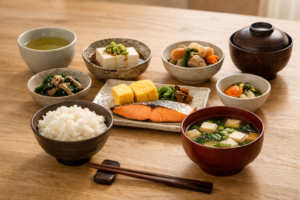
Traditional Japanese diets are high in fatty fish like salmon, mackerel, and sardines rich in omega-3 fatty acids, which research associates with lower chronic inflammation, better blood lipid profiles, and support for brain health. Observational studies suggest that eating more fish and less red or processed meat is linked to lower heart disease risk.
5. Minimal Processed Sugar
Processed sweets and sugary drinks are not part of the traditional Japanese daily routine. Natural sweetness from fruit in moderate portions is the norm. Diets high in added sugars are consistently linked with higher rates of obesity, type 2 diabetes, and fatty liver disease.
Part 2: Body Care — The Less-Is-More Approach
6. A Simple, Consistent Skincare Routine
Japanese beauty culture, often called J-Beauty, focuses on consistency over complexity. A daily routine of gentle cleansing and moisturizing, done reliably, protects the skin barrier and reduces dryness and early signs of aging. Dermatology research consistently supports that a basic routine with a cleanser, moisturizer, and sunscreen is enough for most people.
7. Daily Sun Protection
In Japan, sunscreen, wide-brimmed hats, and UV-protective clothing are worn year-round, including on cloudy days. UV radiation is the primary driver of premature skin aging and a known risk factor for skin cancer. Regular use of broad-spectrum SPF is one of the most evidence-backed skin habits available.
8. Healthy Skin Over Heavy Makeup
Rather than using foundation to cover skin concerns, the goal in Japanese beauty culture is to support skin health at its root through diet, hydration, and gentle care. When the skin barrier is functioning well, redness and breakouts are less frequent.
Part 3: Lifestyle and Movement — Activity as Daily Life
9. Walking as a Default
In Japan, walking to train stations, shops, and workplaces is a normal part of daily life. This low-intensity movement supports cardiovascular health without the stress of high-intensity training. Blue Zones research consistently shows that people in these communities stay active through walking, gardening, and housework not structured gym sessions.
10. Gentle Exercise: Tai Chi and Stretching
Older adults in Okinawa commonly practice Tai Chi or low-impact stretching that focuses on balance, flexibility, and coordination. Evidence supports that balance and flexibility training helps older adults reduce the risk of falls and maintain independence longer.
11. Onsen Culture
Soaking in hot springs, called onsen, is a long-standing Japanese tradition. Warm water soaks help relax muscles, support blood circulation, and may trigger heat shock proteins involved in cellular repair. People with heart conditions or low blood pressure should consult a doctor before using very hot water.
12. Warm Water and Herbal Teas
Staying well-hydrated supports digestion, nutrient transport, and temperature regulation. Many Japanese households drink warm water or herbal teas throughout the day. Consistent hydration matters more than water temperature for most people.
Part 4: Mindset and Mental Health — The Inner Foundation
13. Ikigai: Your Reason for Being
Ikigai, pronounced ee-kee-guy, translates roughly as “reason for being.” A landmark longitudinal study by researchers at the Harvard T.H. Chan School of Public Health, published in 2022, followed older Japanese adults and found that those who reported having ikigai showed lower psychological distress, better subjective well-being, and improved social engagement over three years.
An earlier study tracking over 43,000 participants for seven years found that individuals who reported not having ikigai showed a higher risk of all-cause mortality. Ikigai does not have to be a grand mission. It can be as simple as caring for a garden, cooking for family, or volunteering in your community.
14. Mindful Eating and Living
Eating slowly, savoring flavors, and paying attention to hunger signals are foundational habits in Okinawan culture. Research shows that slower eating correlates with reduced food intake and better feelings of fullness. Mindfulness also reduces chronic stress, which lowers prolonged cortisol exposure linked to weight gain, poor sleep, and increased inflammation.
15. Consistent Daily Routines
Stable sleep and wake times, regular mealtimes, and predictable daily rhythms all support the body’s circadian system. Evidence shows that people with consistent sleep schedules experience better sleep quality and more stable energy levels. You can read more about building better sleep habits in our guide on sleep maxing.
16. Strong Social Bonds and Community
In Okinawa, a community support structure called “moai” describes a small group of lifelong friends who support each other through every stage of life. An 85-year Harvard study on human happiness confirmed that strong relationships are among the most powerful predictors of long-term well-being. Social isolation is associated with elevated stress, poorer heart health, and higher overall mortality risk.
17. Shinrin-Yoku (Forest Bathing)
The Japanese practice of shinrin-yoku involves slow, intentional walks in green spaces. Research suggests that time in natural environments can temporarily lower blood pressure, reduce cortisol levels, and improve mood. You do not need a forest. A 15-minute walk in any green space carries measurable calming effects.
18. Portion Awareness
Traditional Japanese table culture uses small, separate bowls for different foods rather than one large plate. This naturally encourages variety and moderation. Studies in food psychology show that using smaller plates consistently reduces overall food intake without conscious effort.
19. A Calm Home Environment
Many Japanese households practice orderly daily routines tidying spaces, changing out of work clothes when returning home, and creating a quiet atmosphere in the evenings. Evidence from environmental psychology suggests that cluttered surroundings sustain low-level background stress, making it harder to transition into rest mode.
20. Low-Intensity Daily Activity Over Extreme Workouts
Blue Zones research consistently finds that people in these communities do not follow intense training programs. They stay active through gardening, walking, cooking, and housework. Consistent gentle activity across decades adds up to a powerful protective effect for the heart, joints, and metabolism.
How to Build These Habits Into a Busy Modern Schedule
One of the most common reasons people abandon lifestyle changes is trying to fit a completely different routine into an already packed day. Japanese longevity habits work differently. Most of them do not require extra time; they require small substitutions.
Instead of eating lunch at your desk while checking emails, eat without your phone for fifteen minutes. That covers hara hachi bu and mindful eating together. Instead of driving to a nearby shop, walk. That is your daily movement done. Instead of ending the evening with social media, make a cup of green tea and sit quietly for ten minutes.
The habits that last are the ones that replace existing behaviors rather than adding to an already full schedule. Look at your current day and ask, “Where can I swap, not add?”
A useful approach is to pick one habit from each of the four categories diet, body care, movement, and mindset and focus only on those four for the first month. Write them down. Check in with yourself weekly. Small, tracked progress builds the consistency that eventually becomes second nature.
Who May Benefit Most From These Habits?
These habits may be especially relevant for health-conscious adults aged 25 to 65 who want to lower their risk of lifestyle-related conditions before problems develop. They are also well-suited to people with busy schedules who need simple, free, or low-cost strategies that fit into ordinary life.
If you live in a dense urban environment where processed food is highly accessible and daily walking has been replaced by vehicles and delivery apps, these patterns offer a clear practical alternative. They are also a good starting point for anyone who feels overwhelmed by complicated diets or fitness trends and wants something sustainable instead.
Common Mistakes to Avoid
Trying to change everything at once is the most common reason people abandon new habits within weeks. Choose two or three habits that feel realistic and stick with them for a month before adding more.
Treating hara hachi bu as extreme calorie restriction is a mistake. The point is awareness, not deprivation. Aggressive calorie cutting can harm metabolism, mood, and muscle mass over time.
Ignoring sleep and stress while focusing only on diet and exercise is also a trap. Chronic poor sleep and elevated stress undermine almost every other health effort.
Finally, comparing your progress harshly to an idealized version of the Japanese lifestyle misses the point entirely. These habits were built slowly, over decades, within specific cultural contexts. The goal is to borrow the principles and adapt them to your own life.
Frequently Asked Questions
What are Blue Zones, and why is Japan one of them?
Blue Zones are regions where people tend to live significantly longer and healthier than average. Okinawa, Japan, was identified as one of these zones based on demographic data showing high rates of centenarians among generations born before World War II. The pattern is linked to diet, daily movement, community connection, and lifestyle habits.
Is hara hachi bu scientifically proven?
Research supports the idea that eating more slowly and stopping before feeling completely full can reduce daily calorie intake and support lower BMI over time. The broader principles of mindful eating and moderate calorie intake are well-supported.
Does green tea cure any disease?
No. Green tea has meaningful antioxidant properties that may support heart health and general wellbeing. It is not a treatment or cure for any condition.
How important is social connection for longevity?
Several large studies, including the 85-year Harvard Study of Adult Development, link strong social relationships to better long-term health outcomes and lower mortality risk. The evidence here is among the most consistent in longevity research.
Do I need to follow a strict Japanese diet to benefit?
No. The core principles are eating mostly whole plant foods, limiting red and processed meat, cutting down on processed sugar, and staying physically active. These can be adapted to any cultural food tradition.
Does ikigai actually extend your life?
Research suggests that having a strong sense of purpose is associated with lower mortality risk and better physical health outcomes in older adults. The relationship is observational but consistent across multiple studies.
Can I start these habits at any age?
Yes. Research in lifestyle medicine consistently shows that adopting healthier habits at almost any age can improve quality of life and reduce disease risk.
How long before I notice results?
Some people notice better energy or improved sleep within a few weeks of changes like better sleep timing or reduced sugar. Long-term benefits build over months and years. Results vary between individuals.
Are these habits free or low-cost?
Most of them are. Walking, consistent sleep, mindful eating, spending time in nature, and building social connections cost nothing. Green tea and whole vegetables are among the most affordable food choices in most cities.
What is the biggest single change someone can make today?
Reducing processed food and eating more slowly. These two changes touch diet, metabolism, stress, and mindfulness at the same time.
Is the Blue Zones concept controversial?
It has faced criticism around questions about the accuracy of birth records in some regions. The habits linked to longevity in these regions are independently supported by broader nutrition and lifestyle science, regardless of the centenarian count debate.
Can these habits help with stress and mental health?
Yes. Ikigai research, social connection data, mindfulness evidence, and the benefits of nature exposure all point to meaningful improvements in mood and psychological health. These are not replacements for professional mental health support but are genuinely useful complements.
Start Small. Keep going.
The Japanese concept of Kaizen meaning continuous small improvements, is the actual secret behind most of these habits. Nobody in Okinawa sat down one day and decided to overhaul their entire life. They inherited small, sensible patterns and repeated them for decades.
You do not need to do all 20 at once. Start with one cup of green tea instead of a sugary drink tomorrow morning. Walk an extra ten minutes. Eat your next meal without your phone. Those small shifts, repeated consistently, are exactly what the science points to.
Longevity is not a sprint. It is the sum of thousands of ordinary days lived a little more deliberately.
This article is for educational purposes only and does not provide medical advice. Please consult a qualified healthcare professional for personalized guidance.