If you wake up tired more mornings than not, you are not imagining things. You are also not alone.
Hi, I am Jayanthi, and I write SmartLivingBlog from Hyderabad. For most of last year, I was sleeping past midnight and waking up exhausted by 6 AM, managing the blog, family, and everything else in between.
This is not just a personal struggle. A 2024 survey by LocalCircles covering 41,000 respondents across 309 Indian districts found that 61% of Indians are getting less than 6 hours of uninterrupted sleep daily. That number has climbed every single year since 2022. According to the Wakefit Great Indian Sleep Scorecard 2025, between 84 and 90% of Indians use their phones right up until they fall asleep. No wonder half of us wake up exhausted.
In cities like Hyderabad, where IT shifts run late, commutes eat hours, and work pressure rarely switches off, the problem runs even deeper. The good news is that smart health gadgets for sleep are making it genuinely easier to understand your sleep patterns, fix your bedroom environment, and build habits that actually stick. This guide covers everything in plain, practical terms with no jargon, no brand pitches, and just what you need to know to get started.
What Are Smart Sleep Gadgets and What Do They Actually Do?
Smart sleep gadgets are electronic tools that either monitor your sleep or create better conditions for it, right in your own bedroom. Most of them connect to your phone through an app and give you feedback you can actually use.
Think of them like a fitness tracker, but for your nights instead of your steps. They do not replace a doctor, and they cannot force you to sleep. What they can do is show you patterns you would never notice on your own and quietly improve your bedroom environment in the right direction.
There are three main types worth knowing about as a beginner.
Sleep trackers measure how long you sleep and how well. They come as wrist bands, finger rings, or devices you place under your mattress. Wrist and ring options are the most popular. Globally, the wearables segment holds around 75.7% of the entire sleep tech market as of 2024, according to Precedence Research.
Smart lighting refers to bulbs that can change their brightness and color temperature throughout the day. Warm, dim light in the evening helps your body start producing melatonin, which is the hormone that makes you feel sleepy. Bright, cool light in the morning helps you wake up properly.
White noise machines play steady background sounds like rain, a fan, or ocean waves to mask unpredictable noises like traffic, neighbors, or a partner snoring. That consistent sound helps your brain stay asleep instead of reacting to every random disturbance.
How Do These Gadgets Work? A Simple Explanation
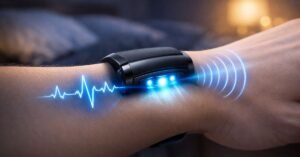
You do not need to understand the engineering to use these tools well. Here is the short version of what is actually happening.
Sleep trackers use a small sensor called an accelerometer that detects tiny movements. When you lie still, the device assumes you are asleep. Most trackers also measure your heart rate and, in some cases, your breathing rate, to estimate which sleep stage you are in. The three main stages are light sleep, deep sleep, and REM. These are estimates and not clinical measurements, but they are accurate enough to show you useful trends over time.
Smart lighting works with your circadian rhythm, which is your body’s built-in 24-hour clock. This clock responds strongly to light. Bright white or blue-tinted light tells your brain it is daytime and slows down melatonin production. Warm, dim light does the opposite. Smart bulbs let you automate this shift so your home environment matches what your biology actually needs, without you having to think about it every night.
White noise machines create what audio engineers call a masking effect. The steady sound raises your background noise level so sudden spikes like a car horn or a door slam do not break through as sharply. Your brain stops treating background noise as a threat and settles into deeper sleep.
Is a Sleep Tracker Worth It for Beginners?
For most beginners, a basic tracker is genuinely useful as a starting point, as long as expectations are realistic.
Consumer sleep trackers are not as accurate as a clinical sleep study done in a hospital. If you want to understand exactly how accurate these devices are before buying, read our detailed breakdown on smart health gadgets accuracy They are particularly less precise when estimating sleep stages like deep sleep. But for tracking your total sleep time, spotting when you woke up, and noticing how your habits affect your nights, they work well enough for daily self-monitoring.
The real value is in the patterns. You might notice that on nights you ate dinner late, your sleep score drops. Or that an extra coffee at 4 pm shows up in your restlessness by midnight. These are things you would never connect without the data sitting in front of you.
What If the Numbers Stress You Out?
Some people find sleep tracking genuinely helpful. Others check the app obsessively and end up more anxious than before. Sleep researchers even have a name for this: orthosomnia, which is excessive worry about achieving perfect sleep scores.
If seeing numbers makes you more stressed, tracking may not be right for you. The point of these tools is to help you, not add one more thing to worry about.
Also worth noting: if you feel extremely tired during the day no matter how much you sleep, snore very loudly, or gasp awake at night, please see a doctor rather than relying on a consumer gadget. Those can be signs of sleep apnea, which needs a proper medical evaluation.
How Can Smart Lighting Actually Improve Your Sleep?
This one is more powerful than most people expect, and it requires the least effort once it is set up correctly.
Most Indian households keep bright overhead lights on until 11 pm or later. That kind of light signals your brain to stay alert and delays your natural sleep timing. Research has consistently shown that bright home lighting in the late evening suppresses melatonin and pushes your sleep schedule later than it should be. You feel wide awake when you should already be winding down.
Smart bulbs let you schedule a gradual shift. Two hours before your target bedtime, the lights can slowly dim and shift from cool white to warm amber. You do not need to remember to do anything because it happens on a timer. In the morning, a sunrise-style light gradually brightens the room, which is far gentler than a sudden loud alarm and actually easier to wake up from.
For busy professionals managing packed schedules, this kind of automation is especially valuable. Once it is set up, it runs in the background every single day without any extra effort from you.
Key Real-World Benefits of Smart Health Gadgets for Sleep
Here are the practical benefits that actually show up in daily life, not just on product spec sheets.
You stop guessing and start seeing. Instead of wondering why you feel tired, a tracker shows your actual average sleep duration, your waking periods, and your trends over weeks. This gives you something real to work with.
Your bedroom starts working for you. Automated lighting and white noise remove two of the most common sleep disruptors, which are wrong light at the wrong time and unpredictable noise, without requiring daily willpower from you.
It motivates habit change. Seeing a weekly sleep score improve, even slightly, is encouraging in the same way that counting steps pushes you to walk more. The data gives you a clear reason to follow through on habits you already know you should build.
It can protect your health long term. Poor sleep is linked to higher blood pressure, weakened immunity, and worse mental health. The National Council on Aging reported in 2024 that around 30% of adults globally experience insomnia symptoms. In India, roughly 1 in 3 people now suspect they have insomnia, according to Wakefit’s 2025 survey. Catching poor sleep trends early is far easier than recovering from health damage later.
It works silently in the background. Unlike a habit you have to consciously maintain every night, a smart lighting schedule or a white noise machine does its job whether you remember to activate it or not. For overwhelmed professionals, that reliability matters a lot.
It is a low-barrier starting point. You do not need to overhaul your life to begin. One smart bulb or one basic wrist tracker is enough to start seeing results after two to four weeks.
It is becoming more affordable and local. India’s sleep aid market reached USD 308 million in 2024 and is growing steadily, with Indian companies now launching products designed specifically for local conditions, power standards, and price points.
Are Smart Health Gadgets for Sleep Right for You?
These tools work best for a specific kind of person. Be honest with yourself about which category fits you.
They are a great fit if you have lifestyle-related sleep problems like irregular work hours, late-night screen use, or a noisy living space. They also work well if you are comfortable using a smartphone app and willing to check your data once or twice a week. If you want to make gradual improvements without committing to major life changes right away, these gadgets are a solid match.
They may not be what you need if you already sleep 7 to 8 hours and wake up feeling genuinely rested. Extra data will not add much value in that case. If watching numbers triggers anxiety for you, tracking can make sleep harder rather than easier. And if you have serious symptoms like loud snoring, gasping in your sleep, or extreme daytime fatigue, a gadget is not the right answer. Those symptoms need a doctor, not a device.
There is no pressure to adopt every new tool on the market. The goal is better sleep, not more tech for its own sake.
Things to Know Before You Buy
These four practical factors will save you from a disappointing purchase.
Connectivity: Almost all smart sleep gadgets use Bluetooth or Wi-Fi to sync with your phone. Make sure your home router reaches your bedroom without signal drops, especially in a larger apartment.
Battery life: Wrist trackers typically need charging every three to seven days, depending on the model. Ring trackers vary by brand. Smart bulbs and white noise machines stay plugged in permanently. Think about which charging routine realistically fits your daily schedule.
Comfort in Indian weather: India’s climate, especially during summer, makes anything that adds warmth on your wrist or finger feel uncomfortable at night. A lightweight soft-strap band or a slim ring design tends to work better than a bulkier smartwatch for overnight use.
After-sales support: Check that the brand has warranty coverage, customer support reachable from India, and an app that works on your phone’s operating system. Privacy policies also matter here. Sleep data is personal biometric data stored on company servers, so read the policy before you sign up.
How to Get Started: Simple Steps for Beginners
Starting does not have to be overwhelming. Pick one device, not three.
A single smart bulb for your bedroom or a basic wrist tracker is enough to begin. Here is a practical four-week plan.
Week 1: Just observe. Install the app, pair your device, and do not change anything about your routine yet. Let the data collect naturally.
Week 2: Spot one pattern. Look at your data and find one thing that clearly affects your sleep. A late dinner? Phone in bed past midnight? Pick the most obvious one.
Week 3: Make one small change. Put your phone on the charger outside your bedroom 30 minutes before bed. Or set your smart bulb to dim at 9:30 pm. Just one change, nothing more.
If you want a complete wind-down plan to pair with your new gadget, our guide on smart living evening routine is a great place to start.
Week 4: Compare. Look at your Week 1 data alongside Week 4. Even small improvements in sleep duration or morning energy confirm that the approach is working.
This slow, deliberate method is more effective than trying to fix everything at once. It also keeps you from burning out on the new gadget within the first week.
Common Mistakes Beginners Make
Checking data obsessively. Looking at your sleep score every morning and treating it like a grade creates unnecessary stress. Use the data weekly, not daily. It is a guide, not a report card.
Expecting gadgets to fix poor lifestyle choices. A tracker cannot undo a strong chai at 9 pm, a midnight doom-scrolling session, or a 2 am work deadline. These tools support good habits but they cannot replace them.
Buying multiple gadgets at once. Beginners often want a tracker, smart lights, and a white noise machine all at the same time. This makes it impossible to know which change actually helped. Start with one, use it for a month, and then add another if needed.
Ignoring medical warning signs. If you wake up gasping, snore loudly enough to disturb others, or feel dangerously sleepy while driving, stop experimenting with consumer gadgets and see a sleep specialist. These are medical issues, not lifestyle ones.
Giving up too early. Sleep improvements from gadgets and habit changes typically take two to four weeks to show clearly in your data. Do not judge the whole experiment after just three days.
If you are still unsure whether gadgets are worth it, read our honest take on why smart gadgets fail to improve life before spending money.
FAQ
Can smart health gadgets for sleep actually improve my sleep? They cannot make you sleep, but they reduce two major barriers: poor light conditions and background noise. They also make your habits visible, which makes it easier to change them. Results vary by person and by consistency.
How accurate are consumer sleep trackers? They are reliable for tracking total sleep time and detecting when you wake up. They are less accurate for estimating sleep stages like deep sleep. Accuracy may vary by brand or model, but they are generally good enough for everyday self-monitoring.
Do I need a smartwatch or is a basic band enough? For beginners, a basic band or a ring tracker is usually sufficient. Smartwatches have more features but also more distractions. Start simple and upgrade later if needed.
Will smart LED bulbs increase my electricity bill? No. Smart LED bulbs use significantly less power than older incandescent or CFL bulbs. The smart features do not add any meaningful energy costs.
Is white noise safe for all ages? Yes, at moderate volume levels it is considered safe for children, adults, and older people. Avoid playing it at very high volumes for long periods, especially near infants.
Can these gadgets replace a hospital sleep study? No. Consumer devices provide useful lifestyle data but cannot diagnose conditions like sleep apnea or restless leg syndrome. If you suspect a medical issue, please see a specialist.
How long should I test a gadget before deciding if it works? Give it at least two to four weeks of consistent use. Patterns take time to appear clearly in the data.
Are there privacy risks with sleep gadgets? Yes. Sleep and heart rate data is biometric and is stored on company servers. Always read the app’s privacy policy before syncing your personal health data.
Do these gadgets work with Indian power and Wi-Fi standards? Yes, most global and local brands are now compatible with Indian power standards at 230V and 50Hz and with standard home Wi-Fi routers. Check the product specifications before purchasing to confirm.
Does better sleep actually affect work performance? Yes. Research consistently links adequate sleep to better decision-making, focus, and emotional control. A 2024 global survey found that 67% of respondents say poor sleep directly impairs their performance at work. This is not a minor issue.
Are there subscription fees for sleep tracking apps? Some brands charge for advanced reports or premium features. Basic tracking is usually free. Check this before committing to a device, as subscription costs can add up over a full year.
What if I am not comfortable with technology? Most smart sleep apps are designed for non-technical users with guided setup and simple dashboards. Start with one device and follow the in-app instructions step by step. If it feels overwhelming after a week, that particular product may not be the right fit for you.
Conclusion
Smart health gadgets for sleep are not magic. But they are genuinely useful tools when you approach them with realistic expectations and a bit of patience.
India is in the middle of a real sleep crisis, with 61% of people not getting enough uninterrupted sleep and that number still climbing each year. These gadgets will not fix systemic work pressure or overnight shifts, but they can help you understand your own patterns, improve your bedroom environment, and build habits that gradually stick.
Start with one device. Use it for a month. Make one small change at a time. That is all it takes to begin.
Better nights are not out of reach. They just need a little attention and the right tools to get started.
The sleep statistics in this article are from publicly available surveys and industry reports. The gadgets covered here are for everyday lifestyle use only. If you think you have a medical sleep condition, please speak to a doctor.