Modern technology can make it easier to pay attention to everyday health habits without turning your home into a medical setup. A fitness tracker can help you notice how much you move during the day. A sleep tracker can show patterns in your bedtime routine, while a digital blood pressure monitor can help with home monitoring when it is appropriate for you.
The important point is that smart health gadgets for home are generally tools for awareness, tracking, and routine support. They should not automatically be treated as replacements for medical equipment, professional advice, diagnosis, or treatment.
For beginners, the biggest challenge is often knowing which type of gadget is actually useful and which features are unnecessary. The right choice depends on what you want to monitor, how often you will use the device, how easy it is to maintain, and whether the information it provides will genuinely help you make better decisions.
This guide explains seven useful categories of smart health gadgets, how they work, who may benefit from them, their limitations, and what to consider before bringing one into your home.
What Are Smart Health Gadgets and What Do They Do?
Smart health gadgets are connected or digital devices designed to help people monitor, understand, or support aspects of everyday health and wellness.
Depending on the device, they may collect information such as:
- Daily steps and physical activity
- Heart rate trends
- Sleep-related information
- Body weight
- Temperature readings
- Blood pressure readings
- Indoor air conditions
- Hydration reminders
Some devices work independently, while others connect to a smartphone through Bluetooth or Wi-Fi. A companion app may then organize the collected information into charts, summaries, reminders, or trends.
However, the word “smart” does not mean that every device provides medically reliable information. Features and accuracy can vary considerably between device types and individual models.
For example, sleep trackers may estimate sleep stages rather than directly measure them. The Sleep Foundation notes that many consumer sleep trackers should be interpreted with caution because they may not consistently identify sleep stages accurately.
That is why it is better to think of many consumer smart health gadgets as wellness and monitoring tools, rather than automatically treating their readings as medical diagnoses.
How Do Smart Health Gadgets Work?
Most smart health gadgets use sensors to collect information and then process that information through the device itself or a connected smartphone application.
For example, a fitness tracker may use motion sensors to estimate activity. A digital thermometer uses a temperature sensor. A smart scale measures body weight and may send the result to an app.
The basic process is usually:
- The device collects information through sensors.
- Software processes the collected information.
- The device displays a reading or summary.
- A connected app may store the information.
- You can use the information to notice patterns over time.
The exact technology differs between devices, so the results should not all be interpreted in the same way.
A useful rule for beginners is simple: use the information to understand trends and support appropriate habits, but do not assume that every reading is a diagnosis.
Which Smart Health Gadgets Are Useful for Home Use?
There is no single device that is right for every household. The most useful option depends on what you actually want to monitor.
Here are seven practical categories worth considering.
1. Smartwatch or Fitness Tracker
A smartwatch or fitness tracker can be a useful starting point for people who want a simple way to become more aware of daily movement and activity.
Many devices can track information such as:
- Steps
- Activity duration
- Heart rate
- Workout sessions
- Sleep-related information
- Movement reminders
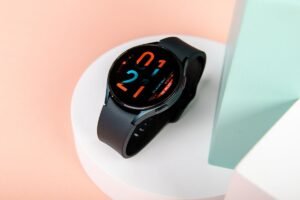
How can a fitness tracker help with daily routines?
A fitness tracker can make everyday activity more visible. Someone who spends several hours working at a desk may notice how little they move during the day and use reminders as a prompt to take short walking or stretching breaks.
The value is not necessarily in hitting a particular number every day. Instead, the device can help you recognize patterns and gradually become more aware of your routine.
For example, you may discover that you are active on weekends but spend most weekdays sitting. That information can help you decide whether adding short movement breaks during workdays would be useful.
What should beginners know?
Do not assume that every measurement is equally precise. Step counts, heart rate estimates, calorie estimates, and sleep measurements can vary depending on the device and how it is worn.
For beginners, simple features are often more useful than a long list of advanced measurements.
Best suited for: people who want basic awareness of movement, activity, and selected wellness trends.
2. Digital Blood Pressure Monitor
A digital blood pressure monitor can be useful for appropriate home monitoring, particularly for people who have been advised by a healthcare professional to check their blood pressure regularly.
Unlike general wellness tracking, blood pressure is a health measurement where proper technique and suitable equipment matter considerably.
The American Heart Association recommends an automatic, upper-arm cuff-style monitor for home monitoring and advises using a validated device with the correct cuff size.
How should you use a home blood pressure monitor?
Before taking a reading, sit quietly and follow the manufacturer’s instructions. Your back should be supported, your feet should be flat on the floor, and your arm should be supported at heart level.
The American Heart Association also recommends avoiding exercise, smoking, and caffeinated drinks for 30 minutes before measuring, resting quietly for at least five minutes, and taking multiple readings as directed.
A single reading is only one measurement at one moment. Looking at readings over time can provide more useful information than reacting to one unusual result.
Is a blood pressure monitor a replacement for a doctor?
No.
Home monitoring can support conversations with a healthcare professional, but it does not replace medical evaluation. You should not change or stop prescribed medication based only on readings from a home device.
Best suited for: households where regular home blood pressure monitoring has been recommended or is otherwise appropriate.
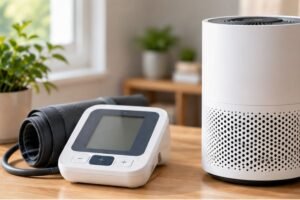
3. Air Purifier
An air purifier is slightly different from the other gadgets on this list because it focuses on the home environment rather than directly measuring your body.
A portable air cleaner can filter certain pollutants from indoor air, depending on its design and filtration system.
The U.S. Environmental Protection Agency explains that portable air cleaners can supplement source control and ventilation, but they cannot remove every pollutant from indoor air.
How can an air purifier support a healthier home environment?
Indoor air can contain particles from sources such as cooking, dust, cleaning activities, tobacco smoke, outdoor pollution, and other household sources.
A suitable air cleaner may reduce certain airborne particles in the area where it is operating. However, controlling pollution sources and maintaining appropriate ventilation remain important parts of indoor air quality management.
What should you check before choosing one?
Consider:
- The size of the room
- Filter type
- Replacement filter availability
- Noise level
- Energy use
- Maintenance requirements
- Whether the device provides useful information about its operation
You should also avoid assuming that an air purifier solves every indoor air-quality problem. Some pollutants are gases, while others settle on surfaces rather than remaining airborne.
For additional information about indoor air quality and air cleaners, visit the U.S. Environmental Protection Agency’s guide to air cleaners.
Best suited for: households looking for an additional way to manage certain airborne particles and improve indoor comfort.
4. Smart Thermometer
A digital or connected thermometer can make temperature measurement quick and easy.
Depending on the model, a thermometer may display readings digitally and, in some cases, store readings in an app or provide additional tracking features.
Why can a digital thermometer be useful at home?
A thermometer is a practical household tool because temperature can be relevant when someone feels unwell.
A connected model may make it easier to record readings over time, particularly when you want to remember when a temperature was measured.
However, you should follow the manufacturer’s instructions for correct use. Different thermometer types can use different measurement methods, and results can vary depending on how and where the measurement is taken.
What is the main limitation?
A thermometer provides a temperature reading. It does not identify the underlying reason for that temperature.
If someone has concerning symptoms, persistent fever, or other health issues, the appropriate response is to seek medical advice rather than relying on the device alone.
Best suited for: families and households that want a convenient digital temperature measurement tool.
5. Smart Weighing Scale
A smart weighing scale can help users monitor body weight over time and, depending on the model, may provide additional body measurements through a connected application.
For beginners, the most straightforward benefit is usually consistent weight tracking.
How can a smart scale help?
Instead of relying on occasional measurements, a connected scale can make it easier to record weight and observe longer-term changes.
This can be useful for someone who is trying to understand whether their routine is generally moving in the direction they expect.
However, daily weight can naturally fluctuate. Changes in hydration, meals, exercise, and other factors can affect the number on the scale.
That means it is usually more useful to look at broader trends rather than becoming concerned about every small day-to-day change.
Should you trust every body-composition number?
Not automatically.
Some smart scales estimate measurements such as body fat or muscle mass using electrical signals and algorithms. These estimates can vary depending on the device and measurement conditions.
For beginners, weight trends may be easier to interpret than trying to treat every additional number as a precise measurement.
Best suited for: people who want a convenient way to record weight trends and maintain awareness of changes over time.
6. Smart Sleep Tracker
Sleep trackers can help users understand patterns in their sleep routine.
Depending on the device, they may provide information about:
- Sleep duration
- Bedtime and wake time
- Night-time movement
- Estimated sleep stages
- Sleep consistency
Can a sleep tracker tell you how well you slept?
It can provide useful estimates and patterns, but it should not be treated as a clinical sleep assessment.
Consumer sleep trackers generally estimate sleep using signals such as movement and heart rate rather than directly measuring brain activity in the same way as a clinical sleep study.
The Sleep Foundation specifically cautions that many consumer devices may not accurately or consistently identify different sleep stages.
The practical value is therefore in identifying patterns.
For example, you might notice that your sleep duration decreases when you stay up late or that your schedule becomes inconsistent during busy weeks.
If improving sleep is one of your wellness goals, you may also find our Smart Health Gadgets for Sleep guide helpful. For evidence-based information about sleep, you can also visit the Sleep Foundation.
Best suited for: people who want to understand general sleep patterns and build more consistent routines.
7. Smart Water Bottle
A smart water bottle can help users remember to drink water by using reminders, tracking features, or smartphone notifications, depending on the model.
Does a smart water bottle actually improve hydration?
Its main advantage is reminding you to pay attention to your drinking habits.
This can be useful for people who become so busy with work, travel, study, or household responsibilities that they forget to drink regularly.
However, hydration needs are not identical for everyone. They can vary based on factors such as activity, climate, diet, age, and individual health circumstances.
Therefore, a smart bottle should be viewed as a reminder tool rather than a device that determines exactly how much water every person needs.
Best suited for: people who frequently forget to drink water and find reminders helpful.
What Are the Main Benefits of Smart Health Gadgets at Home?
The biggest benefit is not the technology itself. It is the additional awareness that useful technology can provide.
1. Better awareness of daily habits
Tracking movement, sleep, weight, or other information can make patterns easier to notice.
2. Easier routine tracking
Digital records can be more convenient than manually writing down every measurement.
3. Helpful reminders
Some devices can remind you to move, check a measurement, or maintain a routine.
4. Long-term trend awareness
Looking at information over time can be more useful than focusing on one isolated measurement.
5. Convenient home monitoring
Certain devices can make appropriate routine monitoring easier without requiring every measurement to be taken outside the home.
6. Support for healthier routines
Seeing patterns can encourage small lifestyle changes, such as taking movement breaks or maintaining a more consistent bedtime.
7. More informed conversations
When appropriate, recorded information can help you explain patterns to a healthcare professional.
The key is to use these benefits realistically. A gadget can support awareness and consistency, but it cannot guarantee better health outcomes.
Are Smart Health Gadgets Right for You?
Smart health gadgets can be useful when the information they provide has a clear purpose in your daily routine.
They may be worth considering if you:
- Want to become more aware of your activity or sleep habits
- Need reminders to maintain a routine
- Have been advised to monitor a particular measurement at home
- Want to record information over time
- Prefer digital tracking over paper notes
- Want to improve your awareness of your home environment
Who may not need them?
You may not need a smart device if:
- You already maintain your routine without tracking
- You are unlikely to use the device consistently
- You find frequent notifications stressful
- You are buying it only because it has many features
- You expect the device to diagnose a health problem
More technology is not always better.
If a simple thermometer or basic weighing scale meets your needs, there may be little reason to pay for additional connected features.
What Should You Know Before Choosing Smart Health Gadgets?
Choosing a gadget should start with your actual need, not the number of features listed on the box.
1. Decide what you want to monitor
Ask yourself one simple question:
What problem am I trying to solve?
If your answer is “I want to move more,” a fitness tracker may make sense.
If your answer is “I have been advised to monitor my blood pressure at home,” focus on a suitable blood pressure monitor rather than buying a general-purpose wearable.
2. Check how the device connects.
Some devices work without a smartphone, while others depend heavily on a companion app.
Before buying, check whether the device requires:
- Bluetooth
- Wi-Fi
- A smartphone app
- An account
- Regular internet access
A device that requires complicated setup may become frustrating if you only want basic information.
3. Consider maintenance.
Smart devices still require ordinary maintenance.
Check whether the device needs:
- Charging
- Battery replacement
- Filter replacement
- Cleaning
- Software updates
- Replacement accessories
For example, an air purifier becomes less useful if its filter is not replaced according to the manufacturer’s instructions. EPA guidance also notes that overloaded or dirty filters may not work well.
4. Think about privacy.
Connected health devices may collect personal information.
Before using a device or app, review:
- What information is collected
- Where it is stored
- Whether information is shared
- What permissions the app requests
- Whether you can delete your account or data
You do not need to become a technology expert. Simply understanding what information the device collects is a sensible first step.
5. Check whether the feature is actually useful
A device may advertise dozens of measurements, but you may only use two or three.
Prioritize the features that solve your actual problem.
How Can Beginners Get Started With Smart Health Gadgets?
You do not need to buy several devices at once.
A simple approach is better.
Step 1: Choose one goal.
Decide whether your priority is activity, sleep awareness, home blood pressure monitoring, temperature tracking, weight tracking, indoor air, or hydration reminders.
Step 2: Choose the simplest suitable device.
Avoid paying for features you do not understand or plan to use.
Step 3: Set it up correctly.
Read the instructions and configure only the features you need initially.
Step 4: Use it consistently.
A gadget becomes more useful when you collect information consistently enough to notice meaningful patterns.
Step 5: Review trends instead of obsessing over individual readings
One unusual result does not automatically explain what is happening.
Look for patterns and consider the context.
Step 6: Take action when appropriate
If the information suggests something worth discussing with a healthcare professional, take the relevant records with you.
If you want to explore more ways technology can support everyday wellness, see our Smart and Health Gadgets Guide.
What Common Mistakes Do Beginners Make?
Smart health gadgets are easiest to use when expectations are realistic.
Mistake 1: Buying too many devices
Buying several gadgets at once can create more data without creating better habits.
Start with one device that addresses a clear need.
Mistake 2: Treating every reading as perfectly accurate
Consumer devices have limitations. Measurements can vary between devices and conditions.
Use appropriate readings as information, not unquestionable facts.
Mistake 3: Ignoring proper setup
Incorrect placement, poor fit, low battery, dirty sensors, or unsuitable measurement conditions can affect results.
This is particularly important for devices such as blood pressure monitors.
Mistake 4: Becoming obsessed with daily numbers
Health-related measurements naturally change.
Constantly checking small fluctuations can create unnecessary worry rather than useful awareness.
Mistake 5: Using gadgets instead of professional care
A smartwatch, sleep tracker, smart scale, or home monitor cannot replace a healthcare professional when medical evaluation is needed.
Use technology as a support tool, not as a substitute for appropriate care.
How Can You Use Smart Health Gadgets Safely?
The safest approach is to understand what a device is designed to do and what it is not designed to do.
Keep these principles in mind:
- Follow the manufacturer’s instructions.
- Use the correct accessories and sizes.
- Keep devices clean and maintained.
- Do not assume consumer measurements are equivalent to clinical testing.
- Do not change prescribed treatment based only on a gadget reading.
- Keep records when a healthcare professional has asked you to monitor something.
- Seek professional advice when symptoms or readings are concerning or persistent.
For blood pressure monitoring specifically, the American Heart Association recommends appropriate equipment, correct cuff fit, proper positioning, and consistent measurement technique.
For indoor air quality, remember that an air purifier is only one part of a broader strategy that can include source control and ventilation.
Frequently Asked Questions About Smart Health Gadgets
1. What are smart health gadgets?
Smart health gadgets are digital or connected devices that help people monitor, track, or support aspects of everyday health and wellness. Examples include fitness trackers, smart scales, sleep trackers, thermometers, and home blood pressure monitors.
2. Are smart health gadgets medical devices?
Not necessarily. Many consumer gadgets are designed primarily for general wellness and tracking. Some devices may have medical applications, but their intended use and regulatory status can vary by product and region.
3. Are smart health gadgets accurate?
Accuracy depends on the device, measurement, design, and how the device is used. Some measurements can be useful for tracking trends, while others may be estimates and should not be treated as medical-grade results.
4. Can a smartwatch replace a doctor?
No. A smartwatch can provide activity and other wellness information, but it cannot replace professional medical evaluation or diagnosis.
5. Is a smart health gadget necessary for a healthy lifestyle?
No. Healthy routines do not require smart gadgets. These devices are optional tools that may make tracking, reminders, or habit awareness more convenient.
6. Can smart health gadgets monitor blood pressure?
Some dedicated home blood pressure monitors can measure blood pressure. For home monitoring, the American Heart Association recommends an automatic upper-arm cuff-style monitor and appropriate measurement technique.
7. Are sleep trackers reliable?
Sleep trackers can provide useful estimates and help identify general patterns, but they should not automatically be treated as accurate measurements of every sleep stage. Consumer sleep-tracking technology has limitations.
8. Can a smart scale measure body fat accurately?
Smart scales may estimate body composition, but these measurements can vary by device and conditions. For beginners, long-term weight trends may be easier to interpret than treating every body-composition number as exact.
9. Does an air purifier remove all indoor pollution?
No. Air purifiers can reduce certain airborne pollutants, but they cannot remove every pollutant. EPA guidance recommends considering source control and ventilation alongside air cleaning.
10. Do smart health gadgets need a smartphone?
Not always. Some devices can display information directly and work independently, while others rely on a smartphone app for setup, storage, or detailed analysis. Check the device requirements before choosing one.
11. How many smart health gadgets should a beginner buy?
There is no fixed number. Starting with one device that solves a specific problem is usually simpler than buying several devices and trying to track everything at once.
12. Should I trust a health gadget reading if I feel unwell?
Do not rely on a consumer gadget alone when you have concerning symptoms. The appropriate response depends on the situation, and professional medical advice may be necessary.
Conclusion
Smart health gadgets can make everyday wellness tracking more convenient, but their real value comes from how thoughtfully they are used. A fitness tracker can increase awareness of movement, a sleep tracker can help identify routine patterns, and an appropriate home blood pressure monitor can support regular monitoring when needed.
The best approach is not to collect as much health data as possible. Instead, choose technology that solves a specific problem, understand its limitations, and use the information as one part of a broader healthy routine.
If you are new to smart health technology, start with one simple goal and one suitable device. Give yourself time to understand the information before adding more technology to your routine.
If you’re new to smart wellness technology, you may also enjoy our How Smart Living Gadgets Make Everyday Life Easier guide.